This is both my Critical Research Journal for my MA in Photography at Falmouth and a journal about the worlds of chronic illness and creativity colliding.
Mirrors and/or Windows?
“…one might characterise the two poles of the medium as the mirror and the window. The photograph as a mirror would be predominantly a picture of the self, made surrogate by the subordination of its nominal subject; as a window, the photograph is an invitation to explore the world of fact.”
Szarkowski, J. (n.d.) Mirrors and windows : American photography since 1960 /. New York : Museum of Modern Art ;
That quote above is one of the photography world’s most loved and well used ways of thinking about photography as an art form. It has occupied our collective minds since it was first put to paper in 1978. Szarkowski, himself a key figure in the birth of photography as an art form, as curator of photography at the Museum of Modern Art in New York City, was in effect saying that there are at two “modes” of photography.
Mirror This is the idea that photography and the act of making an image, reflects the maker, their desires, their pre-occupations. It is self-expression. Identity. Ego.
Window Window is more aligned with pure documentation. Objective approaches to making work. Making an archival record that speaks on it’s own because it is only about the record. This thing looked like this on this day.
Why not both? It’s always seemed to me (and many others, I’m not unique here) that actually all photographic work exists somewhere in between. A unique mix of both. Even when you document something, your interests and passions have drawn you to record that thing. True objectivity is a hard thing to achieve, arguably impossible, and even the most pure documentarians work must necessarily speak of them as a person in some way.
Nan Goldin, I would put to you, exists at both extremes at the same time.
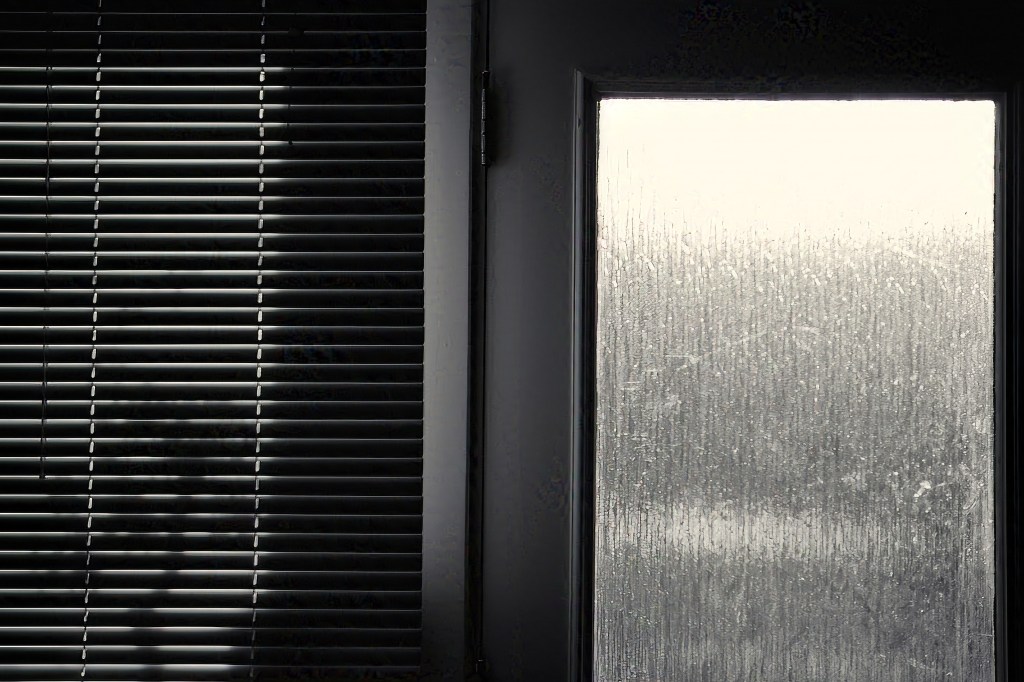
The image above was made in response to this subject. I wanted to muddy the waters somewhat and suggest that – sometimes – a window can still obscure. That actually, a key function of a window (and even a mirror sometimes) is to control light. To allow it in, but also to cover it up, for privacy and to create mood, to create shadow and mystery.
In the essay In Praise of Shadows, Junichiro Tanizaki wrote:
Were it not for shadows, there would be no beauty…
Tanizaki, J. (n.d.) In praise of shadows /. London : Vintage,.
In my image, to my mind, it’s the shadows that are beautiful, the light only goes to show how shabby my soon-to-be-replaced back door is. The window obscures, and the shadows behind the blind tell us there is something behind it. A beautiful bonsai. But the truth is, and Tanizaki would approve here I think, that the bonsai died some time ago; the shadow hides that and only tells of it’s beauty. The elegant, sinuous, path that it once tracked in time.
So to me, mirrors or windows are almost irrelevant as modes. We always exist between the two as photographers. Less two modes, more one slider. The important bit is how you control the light that they let in. How you choose to play in the shadows.
 Photochronical